Wondering how AI is used in drug discovery? In short, machine learning models help researchers pick targets, predict protein shapes, screen molecules and flag likely problems earlier, but laboratory and clinical testing still decide what moves forward.
| Item | Value |
|---|---|
| Phase I success rate reported for AI-discovered molecules | 80-90% |
| Phase II success rate reported for the same group | about 40%, on a limited sample |
| Effort to determine one protein structure experimentally | months to years |
| How long structure prediction was an open research problem | more than 50 years |
These figures come from a 2024 review in Drug Discovery Today and the 2021 AlphaFold paper in Nature. They can change as new data appear, so check the sources before you rely on them.
What AI means in a drug discovery setting
In this field, artificial intelligence mostly means machine learning: statistical models that learn patterns from past data and then make predictions about new cases. The data might be protein sequences, chemical structures, results from lab assays, gene expression profiles or patient records.
The models do not “know” biology the way a scientist does. They estimate which new inputs resemble things they have already seen, and they are only as good as the examples they learned from.
For readers new to the wider field, our explainer on what is drug discovery sets out the stages that AI tools try to speed up or de-risk. Our guide to what is biotechnology covers the broader industry these tools sit inside.
It helps to keep three ideas in mind throughout:
- Prediction is not proof. A model output is a hypothesis to be tested in an experiment.
- Context matters. A model that works well for one protein family or chemical series may fail on another.
- Data quality sets the ceiling. Noisy, small or biased datasets limit what any algorithm can learn.
Where AI fits along the discovery pipeline
Drug discovery is a chain of decisions: which biological target to pursue, which molecule might act on it, whether that molecule is likely to be safe and absorbed, and whether it should go to people at all. AI tools have been proposed for nearly every link in that chain.
The common uses can be grouped like this:
- Target identification: mining genetic, omics and literature data for proteins that may drive a disease.
- Structure prediction: estimating the three-dimensional shape of a target from its sequence.
- Virtual screening: ranking large libraries of compounds by how well they might bind.
- Molecule design: proposing new structures that meet a set of desired properties.
- Property prediction: estimating absorption, metabolism and toxicity risks before synthesis.
Each tool answers a narrow question, and the answers feed into one another. A structure helps with screening, screening results help with design, and design choices are checked against property predictions. Errors can also travel along the chain, so a weak early prediction may quietly shape later decisions.
For that reason, many teams build checkpoints between steps. They compare model output with laboratory data as soon as it exists, and they retrain or retire models that drift away from reality.
None of these steps removes the need for experiments. They mainly change which experiments are run first, and how many dead ends a team may avoid.

Finding targets and predicting structures
Choosing a target is among the riskiest decisions in the process, because a wrong choice can waste years. Models that combine genetics, expression data and published findings try to rank candidate targets by how strongly they appear linked to a disease. Our deeper look at ai target identification explains the data types and the common pitfalls.
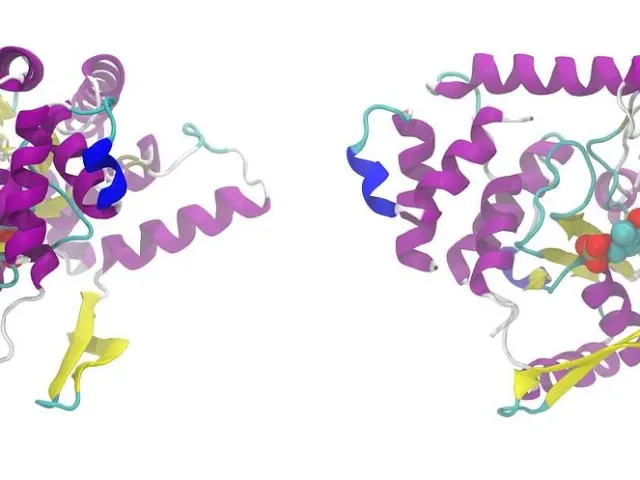
Once a target is chosen, its shape matters, because many drugs work by fitting into a pocket on a protein. According to the AlphaFold paper abstract on PubMed, “structural coverage is bottlenecked by the months to years of painstaking effort required to determine a single protein structure.”
The same abstract says predicting a structure from sequence “has been an important open research problem for more than 50 years.” The authors report that their redesigned model was validated in the 14th Critical Assessment of protein Structure Prediction (CASP14), “demonstrating accuracy competitive with experimental structures in a majority of cases.”
The full Nature paper gives numbers. It reports an all-atom accuracy of 1.5 Å r.m.s.d. for AlphaFold, and a per-residue confidence measure called pLDDT that it says “reliably predicts” the accuracy of the corresponding prediction.
That confidence score is useful in practice, because it tells a scientist which parts of a model to trust and which to treat with caution.
That result changed how many groups obtain a first structural model. Our pages on protein structure prediction in drug discovery and how does alphafold work go through the method and its uses in more detail.
A predicted structure is still a model. It can be less reliable for flexible regions, for proteins that change shape when a drug binds, and for complexes with other molecules. Researchers usually treat it as a starting point for design and for experimental confirmation.
Screening and designing molecules
After a target is chosen, chemists need molecules that bind it. Traditional high-throughput screening tests physical compounds in the laboratory, which is costly. Our guide to virtual screening explained describes docking, similarity searching and learned scoring models.
Generative models go a step further. Instead of searching a fixed library, they propose new structures with drug-like properties as a goal. The topic is covered in our piece on generative ai molecule design.
The authors of the 2024 review suggest that AI “is highly capable of designing or identifying molecules with drug-like properties.” That is a statement about getting to a plausible molecule, not about whether the molecule will help patients, and the two should not be confused.
Typical limits of these methods include:
- Designed molecules can be hard or slow to make in a real laboratory.
- Scoring functions can rank compounds well on average yet be wrong for a specific case.
- Models tend to favour regions of chemical space similar to their training data.
Predicting safety and drug-like behaviour
A molecule that binds a target is only the start. It must also be absorbed, distributed to the right tissues, metabolised at a sensible rate, excreted and tolerated, which scientists summarise as ADMET. Our article on admet prediction machine learning covers what such models can and cannot say.
This matters because a paper in Acta Pharmaceutica Sinica B asks why 90% of clinical drug development fails. The authors argue that current optimisation “overly emphasizes potency/specificity” while overlooking how a drug is distributed in diseased versus normal tissue, which they say may mislead candidate selection.
Failure in the clinic has many possible causes, including a target that does not matter much in the disease, doses that are limited by side effects, and compounds that do not reach the tissue of interest. A model that addresses only one of these will leave the others in place, which is why teams rarely rely on a single prediction.
That is the authors’ proposal, and it is not a settled consensus. It does illustrate why predicting behaviour in the body, not just binding in a dish, is a central goal of many AI efforts.
What the evidence says about success rates
The best-known attempt to measure results is the 2024 analysis by Jayatunga and colleagues, published in Drug Discovery Today. They report that “in Phase I we find AI-discovered molecules have an 80-90% success rate, substantially higher than historic industry averages.”
They add that “in Phase II the success rate is ∼40%, albeit on a limited sample size, comparable to historic industry averages.” In other words, the early advantage in safety-focused trials did not obviously carry into the phase that tests whether a molecule works.
Several cautions apply when reading these numbers:
- Small samples. The authors themselves describe the Phase II figure as resting on a limited sample.
- Different questions. Phase I mainly looks at safety and tolerability, while later phases test efficacy, which is where most programmes historically struggle.
- Selection effects. Companies choose which candidates to advance, and which to publicise, so the group studied may not be representative.
- Early days. Many AI-derived candidates have not yet reached late-stage trials, so the final picture is unknown.
The authors conclude only that their findings “highlight early signs of the clinical potential of AI-discovered molecules.” That is careful wording, and readers should match it. These data do not show that any particular candidate will be safe or effective, and they do not show that AI-based methods will reliably raise approval rates.
Limits, bias and validation
Public assay databases mix results from different laboratories, formats and conditions. Compounds from well-studied target families dominate, which can leave newer biology poorly covered. Our guide to machine learning bias in drug discovery data explains how these gaps arise.
Another gap is the difference between a result on a benchmark and a result in a live project. Benchmarks are fixed and public, so models can be tuned to them, whereas real projects bring new targets, new chemistry and tight timelines. Scientists therefore treat benchmark scores as a rough guide and look for evidence from prospective use.
A second problem is evaluation. A model can look excellent when tested on molecules similar to its training set and then perform much worse on genuinely new chemistry. Sound practice includes held-out test sets split by scaffold or by time, prospective testing, and comparison with simple baselines. We cover this in machine learning model validation drug discovery.
A third problem is interpretability. Many deep learning models give an answer without a clear reason. Teams therefore often pair them with expert review, uncertainty estimates and orthogonal experiments, so that a surprising prediction is checked before money is committed.
Finally, biology is complex. A target that looks promising in cells or animals can behave differently in people, and no current model captures whole-body physiology with full accuracy. That gap is one reason clinical failure remains common even for well-designed molecules.
Common misunderstandings
Because the topic attracts strong claims, a few misunderstandings come up again and again. Clearing them up makes the rest of the literature easier to read.
“AI designs a drug on its own”
In practice, scientists define the problem, choose and clean the data, select the model, interpret the output and decide what to make. Models are tools inside a human-led workflow, and the most useful results usually come from close work between computational and laboratory teams.
“A good prediction means a good medicine”
A model may predict that a molecule binds a target tightly. Whether that molecule reaches the right tissue, avoids harmful effects and changes the course of a disease in people is a separate question that only trials can answer. This is why the gap between a promising computational result and a clinical result is so wide.
“Faster discovery means faster availability”
Shortening an early stage does not shorten the later ones. Safety testing, manufacturing, dose finding and regulatory review each take their own time, and each has its own risk of failure. Any speed gains in the early steps are therefore only part of the story.
“More data always means a better model”
Volume helps only when the data are relevant, consistent and varied. A very large set of near-identical compounds can teach a model less than a smaller, carefully designed set that covers the questions a team really cares about.
What good practice looks like inside a research team
Teams that use these tools well tend to share some habits. They are not guarantees of success, but they reduce the risk of being misled by a model.
- Start with a clear question. A model built to rank compounds for one target should not be reused for another without fresh testing.
- Keep a simple baseline. If a complex network barely beats a simple method, the added complexity may not be worth it.
- Test prospectively. Predictions made before the experiment, then checked afterwards, are more convincing than results fitted to old data.
- Record failures.
- Involve domain experts. Medicinal chemists, biologists and toxicologists often spot predictions that look plausible to a model but not to a person who has made the compounds.
Good practice also includes honest reporting. Papers that state the data splits, the metrics and the cases where the model failed give readers a much better basis for judging how far a result can be generalised.
Decisions about your own diagnosis or treatment should be made with your doctor, so please consult a physician or other qualified clinician instead of relying on an article about research methods.
Where the field may go next
Several directions are being explored, and none is certain to pay off. Better public datasets, produced under consistent conditions, could give models cleaner material to learn from. Automated laboratories could run many experiments chosen by a model and feed the results straight back, which some teams describe as a closed loop between prediction and testing.
Another direction is richer biology. Models that combine genetics, cell imaging, protein data and clinical measurements may capture more of what makes a disease tick than a model based on chemistry alone. The difficulty is that such data are expensive, uneven across diseases and often held privately.
Researchers also discuss shared standards for testing. If groups report results on the same held-out data in the same way, readers can compare methods fairly. Until that is routine, claims from different groups can be hard to line up against each other.
For students and general readers, the practical lesson is steady scepticism combined with curiosity. The methods are real and are used widely, yet the strongest claims should rest on independent, published, peer-reviewed evidence rather than on announcements.
How to read claims about AI-discovered drugs
News about AI in medicine often blurs several different claims. A useful habit is to ask exactly what the model did and what was independently tested. The questions below can help:
- Was the model used for target choice, structure, screening, design or property prediction?
- Was it tested prospectively, on data it had never seen?
- Were results confirmed in laboratory experiments, and by whom?
- Is the claim about a molecule’s design, or about patient outcomes? Only trial data can speak to the second.
- Is the source a peer-reviewed paper or regulator document, or a press release?
Regulators also pay attention to how models are used. Because rules and guidance documents are updated, check the regulator’s own site for the latest position instead of relying on a summary, including this one.
This site is independent and educational. It does not give medical, treatment or investment advice, and the companies, tools or compounds that appear in the literature are mentioned only as neutral examples.

Frequently asked questions
Does AI replace laboratory experiments in drug discovery?
Show answer
No. Models generate predictions and rankings, and those still need to be tested in the laboratory and, much later, in carefully run clinical trials.
Do AI-discovered drugs succeed more often in trials?
Show answer
The 2024 Drug Discovery Today analysis reported an 80-90% Phase I success rate and about 40% in Phase II, on a limited sample. The authors describe this as early evidence only.
Why was AlphaFold a big deal for the field?
Show answer
Experimental structure determination can take months to years per protein, and the Nature paper reports accuracy competitive with experiments in a majority of CASP14 cases. Predictions remain models that need checking.
What is the main weakness of AI models in this area?
Show answer
Data quality and coverage. Biased, small or noisy datasets limit what a model learns, and tests on familiar chemistry can overstate real-world performance.
This article is for information only. It is general education about science and the drug industry, and it is not medical, treatment or investment advice.