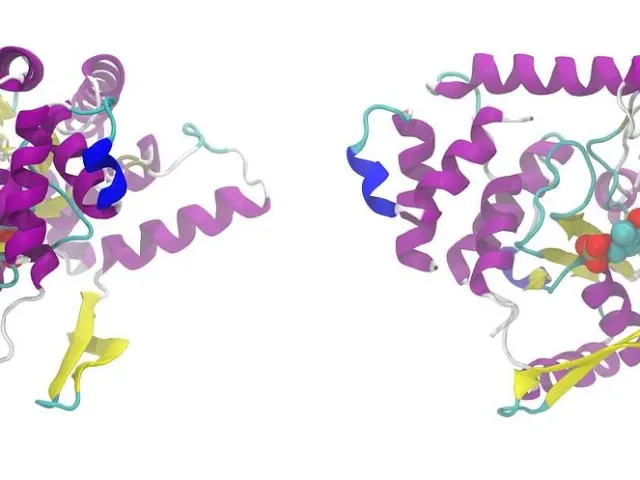
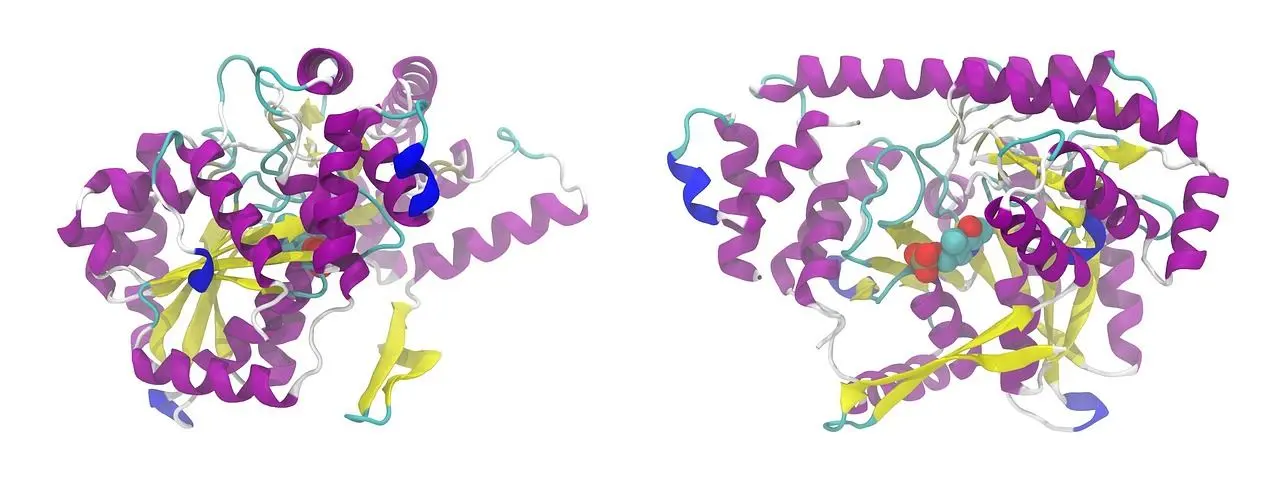
You may be wondering how does alphafold work: a neural network learns patterns from known protein structures and related sequences, then predicts a new protein’s 3D shape from its amino-acid sequence, with confidence scores.
The sections below keep to what published research says and note where the limits are.
This explainer sits within our wider guide to how ai is used in drug discovery.
| Item | Value |
|---|---|
| 2021 AlphaFold paper claim | First computational method to regularly predict protein structures with atomic accuracy, even with no similar known structure |
| Benchmark used in 2021 | The 14th Critical Assessment of protein Structure Prediction (CASP14) |
| 2024 model architecture | Diffusion-based, predicting joint structures of complexes |
| Trunk module in the 2024 model | Pairformer |
| Limitations the authors note | Stereochemistry, hallucinations, dynamics and accuracy for certain targets |
The figures come from the 2021 AlphaFold paper abstract and the 2024 AlphaFold 3 paper. Published results and model versions can change, so check the sources before you rely on them.
What problem does AlphaFold try to solve?
Proteins are chains of amino acids that fold into three-dimensional shapes, and the shape largely determines what a protein can do. Measuring a shape in the lab can be slow and costly, while a sequence is comparatively easy to read.
Structure prediction asks whether the shape can be inferred from the sequence alone. Before AlphaFold, the 2021 paper states that “existing methods fall far short of atomic accuracy, especially when no homologous structure is available.”
For drug discovery, a predicted shape is a starting hypothesis. Teams may use it to think about where a small molecule could bind, but it does not show that a compound will work.
How does AlphaFold work step by step?
The system is a neural network used to predict protein structures. In general, a neural network learns patterns from examples during training and uses those patterns to produce an output for an input. That broad description does not specify which examples a particular model used. Here, the useful distinction is between a predicted structure and an experimental measurement: a prediction proposes a shape, while an experiment supplies evidence against which that proposal can be checked. The reported benchmark results describe how well the predictions agreed with experimental structures in the cases assessed. The exact internals are technical, but the broad flow can be described in plain terms.
- Input: the amino-acid sequence, plus a search for related sequences from other species, called a multiple-sequence alignment.
- Structure building: the network predicts a protein structure.
- Self-scoring: the model reports how confident it is in each region, using scores such as pLDDT and predicted aligned error.
The 2021 authors reported that, in CASP14, the model showed “accuracy competitive with experimental structures in a majority of cases”. The wording matters: it says a majority, not all cases.
What changed in the newer AlphaFold 3 design?
The 2024 paper describes a model with a “substantially updated diffusion-based architecture” that can predict the joint structure of complexes including proteins, nucleic acids, small molecules, ions and modified residues. That widens the scope from single proteins to molecules interacting.
The authors also say the system reduces the amount of multiple-sequence alignment processing by replacing the earlier evoformer with a simpler pairformer. A diffusion module directly predicts raw atom coordinates. Coordinates describe positions in three-dimensional space; together, the predicted positions describe the proposed molecular structure. The supplied paper excerpt identifies this output and the module that produces it. It also contrasts the newer module with the earlier structure module, which used amino-acid-specific frames and side-chain torsion angles. These are different ways of representing molecular geometry. For a reader interpreting a result, the key point is that the output remains a prediction of where atoms are arranged, with the limitations the authors describe below.
The paper reports gains over specialised tools for protein-ligand, protein-nucleic acid and antibody-antigen predictions. These are benchmark comparisons from the authors, and results on your own target of interest may differ.
What can these systems not do?
The AlphaFold 3 authors list their own limits: “We note model limitations of AF3 with respect to stereochemistry, hallucinations, dynamics and accuracy for certain targets.” Each deserves a plain explanation.
- Hallucination: the paper says “generative models are prone to hallucination, whereby the model may invent plausible-looking structure even in unstructured regions.”
- Dynamics: proteins move, bend and change shape, while a prediction is usually a single snapshot.
- Uneven accuracy: some targets are predicted much better than others, which is why confidence scores matter.
- Not a drug result: a good shape does not tell you whether a molecule is safe, effective or can reach its target in the body.
Where does structure prediction fit in drug discovery?
Drug discovery usually starts with a biological target, often a protein, and a question about how a molecule might interact with it. A predicted shape may help researchers frame a hypothesis about that interaction, particularly when no experimental structure exists yet. A hypothesis is a proposal to investigate, rather than a demonstrated result. For example, asking where a molecule might bind is different from establishing that it binds there under experimental conditions. The prediction can be considered alongside other evidence when deciding what to test. The benchmark comparisons described here concern structure prediction accuracy; they do not establish how much time a research project would save or whether a proposed compound would become a useful medicine.
The 2024 paper reports results for protein-ligand interactions, where a ligand is a small molecule that binds a protein. Even so, the authors compare against docking tools on benchmark sets, which is different from showing that a candidate will behave well in a living system.
- Useful for: generating hypotheses about shape, binding regions and how chains assemble.
- Not enough for: judging safety, dose, side effects or whether a compound helps patients.
- Still required: laboratory experiments, animal or cell studies where relevant, and regulated clinical trials.
Anyone with a personal health question should speak to a physician or other qualified clinician, because a structure prediction says nothing about treatment decisions for an individual.
Why do evolutionary patterns matter to the model?
The 2024 paper describes multiple-sequence alignment processing as part of the model.
The newer model leans less on that alignment, but the principle still shapes what the network can learn. In general, what a neural network learns depends on the examples available during training. That is a general point about machine learning, rather than a description of the training data for this particular system. Related sequences provide a way to compare patterns across proteins, but the presence of such patterns does not by itself prove a predicted shape is correct. The supplied paper excerpt supports the narrower architectural point: the newer design reduces alignment processing and uses a simpler pairformer module. Assessing a particular output still requires attention to confidence and experimental evidence.
How should predictions be checked?
A predicted structure is a model, so it needs validation against experiments such as crystallography or cryo-electron microscopy. Low-confidence regions should be treated cautiously.
Data coverage can skew what a model learns, a theme explored in our piece on machine learning bias in drug discovery data. For how teams test whether a model generalises, see our overview of machine learning model validation drug discovery.
In short, these tools are best read as fast, informative hypotheses that sit alongside laboratory work rather than replacing it.
Frequently asked questions
Does AlphaFold use a multiple-sequence alignment?
Show answer
Yes. The 2024 paper describes reducing, but not removing, multiple-sequence alignment processing compared with the earlier design.
Can AlphaFold predict how a drug will behave in people?
Show answer
No. It predicts molecular structure, not safety, dosing or clinical outcomes, which need laboratory and clinical testing.
What does the confidence score mean?
Show answer
The model outputs a predicted local distance difference test (pLDDT) and a predicted aligned error matrix. Higher confidence generally goes with more reliable regions.
Is a predicted structure always correct?
Show answer
No. The authors of the 2021 paper report accuracy competitive with experiments in a majority of cases, and the 2024 authors note hallucination as a risk.
This article is for information only. It is general education about science and the drug industry, and it is not medical, treatment or investment advice.