
Wondering how researchers sift through millions of molecules without testing each one? Virtual screening explained simply: software ranks a digital library by how likely each compound is to bind a target, so labs test far fewer.
| Item | Value |
|---|---|
| Structure-based virtual screening is also known as | Molecular docking |
| Most popular docking software in a survey of prospective studies | GLIDE |
| Docking series noted for large-scale screening | DOCK 3 series |
| Typical validation in most surveyed studies | In vitro bioassays only |
| Main limiting factor named in a Nature Reviews Drug Discovery review | Imperfections of scoring functions |
Figures come from a survey of prospective docking studies and a Nature Reviews Drug Discovery review. Findings can change as methods evolve, so check the sources before you rely on them.
This guide is an independent, educational overview. It is part of our wider coverage of how ai is used in drug discovery.
What virtual screening does
Think of it as triage. Instead of physically testing every molecule in a collection, a team first lets software score them, then tests only the best-ranked fraction and a few controls.
Virtual screening is a computational filter. It takes a large library of compounds stored as digital structures and ranks them by predicted suitability for a biological target, such as a protein involved in a disease.
The goal is enrichment, not proof. A good run puts more true binders near the top of the list than random picking would, so the compounds sent to the lab are a better-chosen sample.
Two main families of methods
Methods are usually split by what information they use.
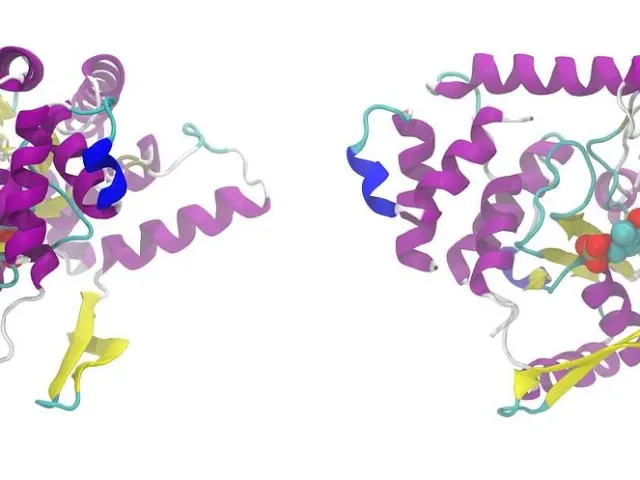
- Structure-based: uses the three-dimensional shape of the target. Docking tries to fit each molecule into a binding pocket and scores the fit.
- Ligand-based: uses molecules already known to be active.
How a docking screen works step by step
The survey of prospective studies describes structure-based screening, also called docking, as a way to find small molecules complementary to a target pocket.
Target structures may come from experiments or from predictions; see our piece on protein structure prediction in drug discovery for that side. Software choice varies: the same survey reports that GLIDE was the most popular docking program, while the DOCK 3 series showed strong capacity for large-scale screening.

What goes in: libraries, targets and compute
A screen is only as good as its inputs. The compound library may be a vendor catalogue of purchasable molecules, an in-house collection, or a virtual set of molecules that could be made but do not yet exist.
The target matters just as much. For structure-based work you need a reliable three-dimensional model of the binding pocket.
Compute is the third input. Screening very large libraries needs many processors, and the survey of prospective studies singles out the DOCK 3 series for strong capacity at that scale. Faster hardware lets teams screen more, but it does not fix a weak scoring function. It can simply produce errors at greater speed.
After the run, human judgment returns. Chemists usually inspect top-ranked structures, remove molecules that look reactive, unstable or hard to make, and pick a diverse set rather than many near-identical copies.
Where virtual screening falls short
Docking has two jobs: placing a molecule in the pocket, then judging how well it fits. Placement is considered the more solved problem, while judging is where most errors arise.
The weakest link is usually scoring. The Nature Reviews Drug Discovery review argues that robust docking algorithms exist, whereas imperfections of scoring functions remain a major limiting factor.
A more recent benchmarking paper explains why: to screen many compounds quickly, scoring functions are often simplified, and approximate versions very rarely correlate well with measured binding affinities. The result can be many false positives, meaning compounds that rank well but fail in the lab.
Other limits include rigid treatment of a flexible protein, unreliable input structures and library bias. Reported success also depends on how it is measured, and most surveyed studies used only in vitro bioassays, which might limit what can be said about the hits afterwards.
How to judge a virtual screening claim
Headlines about screened libraries can sound more certain than the work behind them. A few questions help you read a report critically.
- Was it tested in the lab? A purely computational result is a hypothesis. Prospective studies, where compounds were actually ordered and tested, carry more weight than retrospective benchmarks.
- What was the comparison? Enrichment only means something relative to a baseline, such as random selection or a simpler method.
- How were decoys chosen? Benchmarks rely on decoys, compounds assumed inactive. Poorly chosen decoys can make a method look better than it is.
- Are the hits new? Finding compounds close to known ones is easier than finding chemically novel starting points.
- How far did the follow-up go? The survey of prospective studies notes that limited validation might restrict further characterisation of hits.
The benchmarking paper uses ROC curves, which plot the true positive fraction against the false positive fraction, to show how well a method separates known actives from decoys. A curve alone does not show how a method will behave on a target nobody has screened before.
Why researchers still use it
Physical screening of very large collections is slow and costly, and most compounds tested are inactive. A computational pre-filter can narrow the field so that bench time goes to a smaller, more promising set.
It also lets teams explore compounds before anyone has made them. That widens the search beyond what sits on a shelf, though every selected molecule must still be bought or synthesised and then tested.
Virtual screening is one early step in a long pipeline. A compound that binds a target in a test tube still faces questions about selectivity, safety and manufacturing, which are far outside what a docking score can answer. Decisions about any treatment belong with qualified clinicians and regulators, so please speak to a physician about personal health questions rather than relying on research news.
How it fits with AI and other tools
Machine-learning scoring is an active research area, and one benchmark compared GNINA with AutoDock Vina on enrichment and true versus false positive separation. Such results come from curated test sets, so they may not carry over to a new target.
Virtual screening also pairs with design tools. Screening ranks existing compounds, while generative ai molecule design proposes new ones that can then be screened in turn.
Frequently asked questions
Does virtual screening replace laboratory testing?
Show answer
No. It prioritises compounds for experiments. Predicted hits still need to be tested, and many will not confirm.
Is virtual screening the same as docking?
Show answer
Not exactly. Docking is the structure-based form of virtual screening. Ligand-based and machine-learning methods are also virtual screening.
Why do scoring functions cause false positives?
Show answer
They simplify protein-ligand interactions for speed, so their scores often track measured binding poorly.
Who can run a virtual screen?
Show answer
Several docking programs are available to research groups, and the cited survey names GLIDE and the DOCK 3 series among them. Good results still depend on careful preparation and expert review of the output.
Does a high rank mean a compound would make a medicine?
Show answer
No. A rank is only a prediction of binding to one target. It says nothing about safety, effectiveness or whether the compound could become a drug.
This article is for information only. It is general education about science and the drug industry, and it is not medical, treatment or investment advice.