Wondering how far you can trust a predicted shape? Protein structure prediction in drug discovery is useful for modelling targets and pockets, but it is not a substitute for experiments, especially when ligands are involved.
This guide is part of our wider overview of how ai is used in drug discovery.
| Item | Value |
|---|---|
| Experimentally solved unique proteins (as reported in the AlphaFold paper) | Around 100,000 |
| Benchmark where AlphaFold was validated | 14th Critical Assessment of protein Structure Prediction (CASP14) |
| AlphaFold 3 architecture | Diffusion-based, predicts complexes with proteins, nucleic acids, small molecules and ions |
| AlphaFold 3 chirality violation rate on the benchmark | 4.4% |
| Docking into AlphaFold2 models vs homology models | Not significantly more accurate |
Figures come from the first AlphaFold paper abstract and the AlphaFold 3 paper. They can change as methods and benchmarks are updated, so check the sources before you rely on them.
Why predicted structures matter for drug discovery
Drugs usually work by fitting into a pocket on a protein, so knowing the three-dimensional shape helps chemists reason about what might bind. Solving shapes experimentally is slow: the authors of the AlphaFold paper note that around 100,000 unique proteins have had their structures determined, a small fraction of the billions of known protein sequences.
Prediction methods try to fill that gap from sequence alone. Choosing which protein to model is a separate question, covered in our piece on ai target identification.
How the main methods work
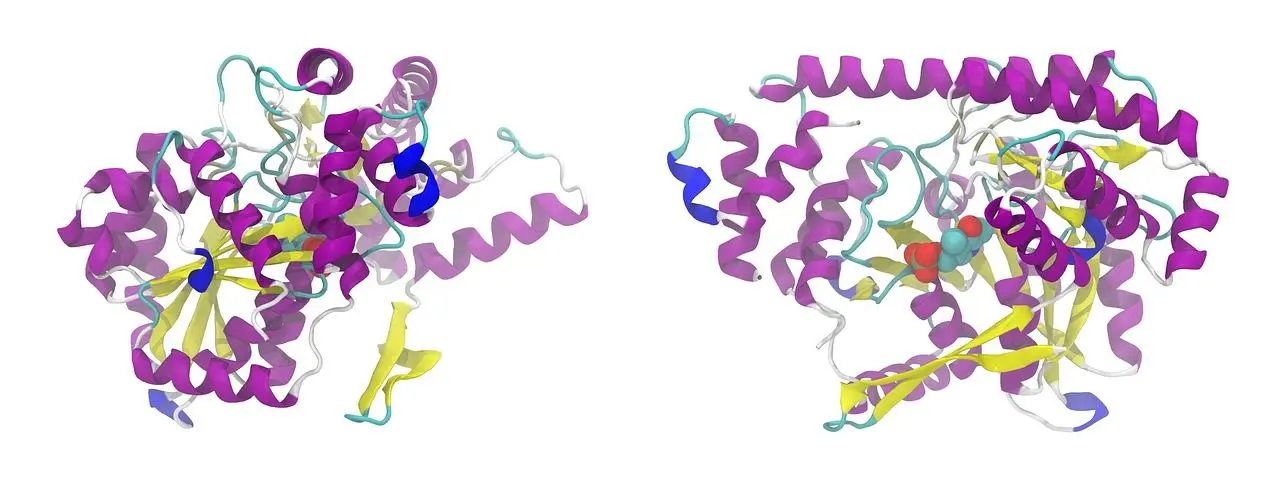
Deep-learning predictors learn patterns linking amino-acid sequences to folded shapes, using known structures as training data. The first AlphaFold paper reports that the system can regularly predict protein structures with atomic accuracy even when no similar structure is known.
Its authors validated the redesigned model in CASP14, reporting accuracy competitive with experimental structures in a majority of cases.
The later AlphaFold 3 paper describes a substantially updated diffusion-based architecture. It predicts the joint structure of complexes that include:
- proteins
- nucleic acids
- small molecules
- ions and modified residues
The authors report far greater accuracy for protein-ligand interactions than state-of-the-art docking tools on their benchmarks. Independent testing on other targets is still needed to know how far that carries over.
Where predictions fall short
The AlphaFold 3 authors list their own model limitations: stereochemistry, hallucinations, dynamics and accuracy for certain targets. Outputs do not always respect chirality, and they still observe a chirality violation rate of 4.4% in the benchmark.
The same paper says generative models are prone to hallucination, where the model may invent plausible-looking structure even in unstructured regions. A confident-looking picture is therefore not proof of a real fold.
Predictions are also usually single snapshots. Proteins move, and a pocket that opens only when a drug approaches may not appear in a static model.
What happens when you dock into predicted models
A peer-reviewed study on drug-binding modes found that AlphaFold2 models capture binding pocket structures much more accurately than traditional homology models. However, the accuracy of ligand-binding poses from docking to those models was not significantly higher than docking to homology models.
It was also much lower than docking to structures determined experimentally without these ligands bound. The authors also note that AlphaFold2 does not allow you to specify a bound ligand when generating a model.
This is why virtual screening explained pieces usually stress checking models against experimental data before ranking compounds. The docking study is available on PubMed Central.
What a structure model can and cannot tell you
A predicted structure is a hypothesis about shape. It can help a team decide which region of a protein to focus on, suggest which residues might line a pocket, or give a starting point when no experimental structure exists.
It does not measure how tightly a compound binds, whether the compound reaches the protein inside a cell, or whether it is safe. Those questions depend on laboratory assays and, much later, on carefully run clinical studies.
The reported results also come from specific benchmarks. A method that performs well on one set of proteins, such as the community challenge used in CASP14, may behave differently on unusual targets, flexible regions or complexes with unfamiliar chemistry.
For that reason, many research groups use predictions alongside experimental methods rather than instead of them. A prediction can narrow the options, and an experiment can then confirm or contradict it.
Nothing here is medical advice, and decisions about treatment should be made with your physician, because structure models say nothing about what is right for an individual patient.
Why the gaps matter for the pipeline
Early drug research is a funnel. Many candidate molecules are proposed, most are discarded, and each step of the funnel relies on models that carry some error.
If a structural model places a ligand in the wrong spot, that error can propagate into every later ranking. A team that trusts the model without checking may spend laboratory time on compounds that were favoured only by a flawed pose.
Three kinds of uncertainty are worth keeping apart:
- Shape uncertainty: whether the backbone and side chains are placed correctly.
- Interaction uncertainty: whether a small molecule sits where the model says, which the docking study above found to be much weaker than pocket shape alone would suggest.
- Dynamic uncertainty: whether the protein moves in ways a single snapshot misses, a limitation the AlphaFold 3 authors list themselves.
Being open about each kind helps readers judge claims. A statement such as “the structure was predicted” is only the start of the evidence, and it should be followed by experimental testing before anyone draws further conclusions.
Reported benchmark results are also averages. A method can be strong overall yet unreliable for the one protein a team cares about, so per-target checks remain part of careful practice.
Practical ways to read a predicted structure
Readers who see a predicted structure in a paper or press release can ask a few plain questions. The steps below are a reading aid, not a laboratory protocol.
- Check the model’s per-region confidence and treat low-confidence regions as guesses.
- Compare against any experimental structure of the same or a related protein.
- Remember that a pocket shape from a ligand-free prediction may differ from the ligand-bound form.
- Treat docking scores on predicted models as hypotheses for lab testing, not results.
Frequently asked questions
Can predicted structures replace experimental ones?
Show answer
Not reliably. The studies cited here report strong accuracy in many cases, but also limits such as hallucination and weaker docking results than with experimental structures.
What is CASP14?
Show answer
It is the 14th Critical Assessment of protein Structure Prediction, a community benchmark in which the AlphaFold authors validated their redesigned model.
Does AlphaFold 3 predict small molecules binding?
Show answer
Its authors describe joint prediction of complexes including small molecules and report strong benchmark results, but they also list limitations in stereochemistry and dynamics.
Does a good prediction mean a drug will work?
Show answer
No. A structure model alone does not establish safety or clinical outcomes; it is only one input to early research.
This article is for information only. It is general education about science and the drug industry, and it is not medical, treatment or investment advice.