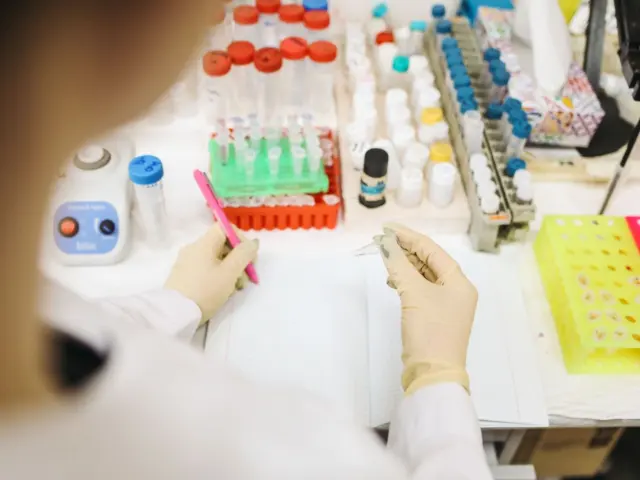

Wondering what happens after a screen finds a promising molecule? Hit to lead optimization is the stage where chemists and biologists test, reshape and rank early compounds until a few look worth deeper work.
This guide sits within the wider topic of what is drug discovery, and it focuses on the step between a first screening result and a preclinical candidate.
| Item | Value |
|---|---|
| Assay design idea for early discovery | A “testing funnel” of assays to identify genuine hits |
| Where measurement quality is critical | High-throughput screening, hit validation, lead optimization and regulatory enabling studies |
| Era when automated lead optimization approaches emerged | The mid-to-late 1990s |
| Plate formats used in miniaturized assays | 96-well, 384-well and 1536-well plates, with volumes under 10 μL |
| Reported aim of physicochemical risk reduction | Could help to reduce clinical attrition rates |
The figures come from an NIH-hosted Assay Guidance Manual tutorial and a PubMed Central article on lead optimization. They can change as the literature develops, so check the sources before you rely on them.
What a hit and a lead actually are
A hit is a compound that shows some desired activity against a biological target in a screening assay. It is a starting point, not a candidate, and many hits turn out to be artifacts or are chemically unsuitable.
A lead is a compound, or a small family of related compounds, that has been confirmed and improved enough to justify further investment. Teams usually want evidence that the activity is real, that the structure can be changed, and that early safety and handling properties are not obviously poor.
The assay work behind this is described in the NIH-hosted Assay Guidance Manual tutorial. It says the manual provides guidance for designing a “testing funnel” of assays to identify genuine hits using high-throughput screening and advancing them through preclinical development.
How hit to lead optimization works step by step
The work is iterative rather than linear. Each cycle asks the same question: does this change make the molecule better overall, or only better on one measure?
- Confirm the hit. Repeat the measurement and test fresh material.
- Group hits into series. Compounds with a shared core structure are clustered so teams can see which scaffolds have room to improve.
- Map structure-activity relationships. Chemists make small variants and record how each change shifts activity.
- Check early drug-like properties. Solubility, metabolic stability and permeability are measured alongside potency.
- Select a few series. Only those with a credible path forward move into lead optimization proper.
Measurement quality matters at every step. The Assay Guidance Manual tutorial states that validity, reproducibility, and stability of these measurements are critical in high-throughput screening, hit validation, lead optimization, and regulatory enabling studies.
What chemists try to improve
No single number defines a good lead. Teams usually track several properties at once and accept that gains in one can cost another.
- Potency: how much compound is needed to produce an effect in an assay.
- Selectivity: whether the compound avoids unrelated targets that could cause side effects.
- Solubility and permeability: whether the molecule can dissolve and cross biological membranes.
- Metabolic stability: how quickly liver enzymes break the compound down.
- Early safety signals: for example, interactions with enzymes that process other drugs.
The PubMed Central article notes that lead optimization trajectories aimed at reducing physicochemical risk, assisted by ligand efficiency metrics, could help to reduce clinical attrition rates. The wording is hedged for good reason: it describes a possibility that may not hold for every project.
How teams decide which series to keep
Decisions are rarely made on one chart. Teams compare series side by side and ask which one has the most room left to improve without running into a hard limit.
The NCATS Assay Guidance Manual page describes the manual as a free, best-practices online resource devoted to the successful development of robust, early-stage drug discovery assays. It says investigators can use it to design biologically and pharmacologically relevant assays for high-throughput screening and lead optimization.
Typical questions at a review meeting include:
- Is the activity reproducible across independent batches of the compound?
- Can chemists make analogs quickly enough to keep learning?
- Does the series have a distinct structure, or is it too similar to existing known compounds?
- Are the problems found so far fixable, or built into the core structure?
Where computers and automation fit
Teams often describe the work as a loop of design, make, test and analyze. Each pass produces data that feeds the next round of design, so the speed of each pass strongly shapes how far a project can get.
Automation has shaped this stage for decades. The Assay Guidance Manual tutorial says automated high-throughput screening platform and lead optimization approaches were developed in the mid-to-late 1990s, using robotics, workstations and miniaturized assay formats.
Those formats include 96-well, 384-well and 1536-well plates with assay volumes below 10 μL, according to the same tutorial. Smaller volumes save material and let teams test more compounds.
Limits, uncertainty and failure
Most optimized compounds still do not become medicines. A molecule can perform well in cell assays and then behave differently in animals or people, which is one reason why why do drugs fail in clinical trials remains such a large question for the field.
- Laboratory assays are simplified models of human biology.
- Improving one property can quietly damage another.
- Early series can be chosen on incomplete data, and dead ends are often found late.
- Measurement noise can make small differences between compounds look meaningful.
For the full sequence that follows this stage, see the overview of drug development process stages. Nothing here is medical advice, and anyone with questions about a health condition or a treatment should speak to a physician or other qualified clinician.
The same caution applies to the science itself. Reports from early discovery describe laboratory behavior of molecules, and they say little about how a compound would act in a person.
It also helps to remember that the field keeps changing. Methods, benchmarks and rules of thumb are revised as new data appear, which is why the sources above are best treated as snapshots rather than fixed rules.
Frequently asked questions
What is the difference between a hit and a lead?
Show answer
A hit shows activity in a screen. A lead has been confirmed, characterized and improved enough that a team is willing to invest in optimizing it further.
Is lead optimization the same as hit to lead?
Show answer
Not quite. Hit to lead usually narrows and validates early hit series, while lead optimization then refines the chosen series toward a preclinical candidate. In practice the boundary varies between organizations.
Why can’t teams just maximize potency?
Show answer
A very potent compound may dissolve poorly, break down quickly or hit unrelated targets. Teams therefore weigh several properties together.
Does an optimized lead mean a future drug?
Show answer
No. Later animal and human studies often reveal problems that laboratory tests did not.
This article is for information only. It is general education about science and the drug industry, and it is not medical, treatment or investment advice.